


Canadian skincare decoded: What sets it apart for healthy skin
TL;DR:
- Canadian skincare is formulated for extreme climates, focusing on barrier repair and climate adaptability.
- Strict Health Canada regulations ensure ingredient transparency and safety for sensitive skin.
- Clinical data shows Canadian products effectively improve hydration, firmness, and skin tone.
Canada’s climate is not gentle on skin. Winters bring biting cold and indoor heating that strip moisture fast, while summers deliver intense UV exposure that triggers hyperpigmentation and sensitivity. These are not minor inconveniences — they are real, recurring challenges that affect how your skin looks and feels year-round. Canadian skincare refers to products made by Canadian brands or in Canada, distinguished by formulations adapted to these extreme conditions. This article breaks down what makes Canadian skincare different, which ingredients matter most, how Health Canada keeps products safe, and what clinical results actually look like for women dealing with dryness, sensitivity, and uneven tone.
Table of Contents
- What makes skincare Canadian?
- How Canadian skincare targets dryness, sensitivity, and hyperpigmentation
- Regulatory standards and safety in Canadian skincare
- Real results: Clinical data and user experiences
- Our perspective: What most people miss about Canadian skincare
- Discover Canadian skincare solutions tailored for you
- Frequently asked questions
Key Takeaways
| Point | Details |
|---|---|
| Made for Canadian climates | Canadian skincare addresses extreme dryness, sensitivity, and sun exposure unique to Canada. |
| Strict safety regulations | Products must meet Health Canada standards, ensuring safe, transparent ingredients. |
| Evidence-based ingredients | Formulations feature lipids, peptides, and local botanicals with clinical data supporting their effectiveness. |
| User-focused for real results | Reviews and trials show visible improvements in skin hydration, barrier strength, and tone. |
What makes skincare Canadian?
Not every product sold in Canada qualifies as Canadian skincare. The term refers specifically to brands formulated and often manufactured here, with a deliberate focus on the conditions Canadian skin actually faces. That means cold-weather barrier repair, humidity-responsive hydration, and UV-driven pigmentation control — not just trendy ingredients borrowed from global markets.
Canadian skincare brands build their formulas around climate-adaptive priorities. A moisturiser designed for a mild European winter simply will not perform the same way during a Canadian January in Winnipeg or Edmonton. Local brands understand this because they live it.
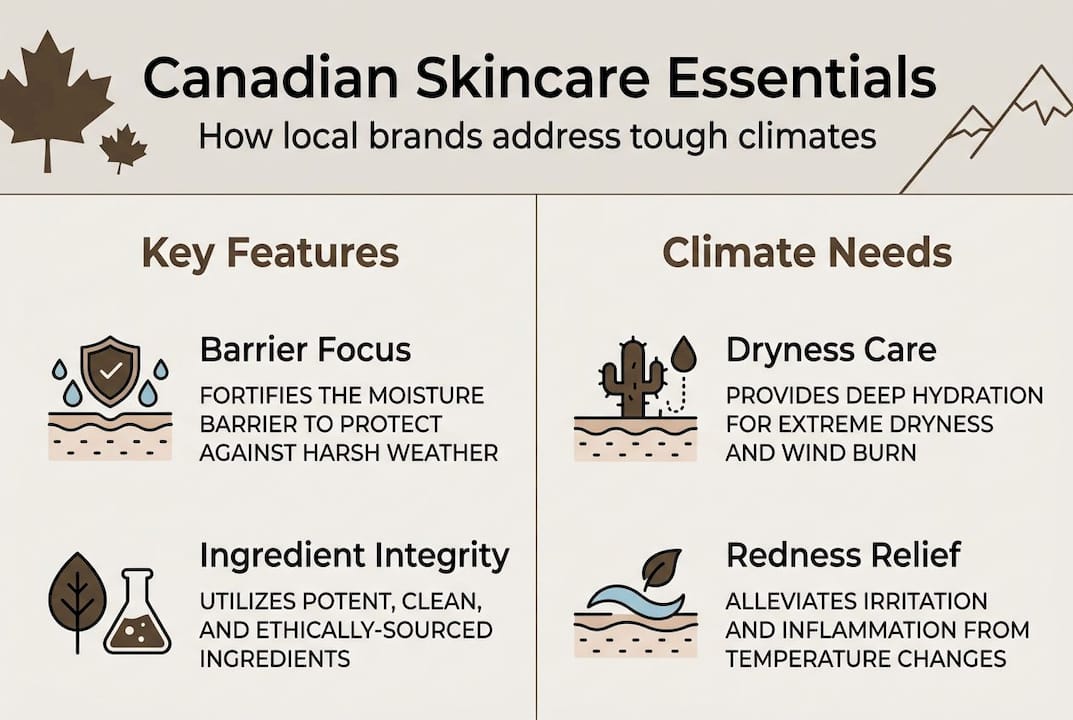
What also separates Canadian skincare from mass-market global options is a commitment to barrier-focused, science-backed formulas that prioritise dryness and sensitivity in women aged 25 to 45, exclude common irritants, and use locally sourced or clinically validated ingredients under strict regulatory oversight. That is a meaningfully different standard than what many international brands apply.
Here is how Canadian skincare compares to typical global skincare at a glance:
| Feature | Canadian skincare | Typical global skincare |
|---|---|---|
| Climate focus | Extreme cold and UV seasons | Mild or generalised climates |
| Barrier repair priority | High | Variable |
| Fragrance use | Minimal or excluded | Common |
| Regulatory oversight | Health Canada (strict) | Varies by country |
| Local ingredient sourcing | Frequent | Rare |
| Sensitivity-first formulation | Standard | Often secondary |
Key characteristics that define genuinely Canadian skincare include:
- Barrier repair as a foundation, not an afterthought
- Ingredient transparency, with full INCI (International Nomenclature of Cosmetic Ingredients) labelling
- Avoidance of known irritants such as synthetic fragrance, denatured alcohol, and harsh preservatives
- Seasonal adaptability, with formulas that account for seasonal skincare for sensitive skin across Canada’s dramatic climate shifts
- Science-backed actives that address real concerns rather than marketing-driven trends
This combination of local context, regulatory rigour, and ingredient integrity is what makes Canadian skincare a genuinely distinct category.
How Canadian skincare targets dryness, sensitivity, and hyperpigmentation
Understanding the roots of Canadian skincare, let’s see how brands tackle real-world skin challenges. Three brands consistently lead the conversation: Skinfix, Regimen Lab, and Province Apothecary. Each takes a different approach, but all share a commitment to formulation integrity.
Skinfix excels for dryness and sensitivity with its triple lipid-peptide cream, Regimen Lab focuses on hyperpigmentation correction, and Province Apothecary specialises in sensitive organic formulas. These are not interchangeable — each serves a specific skin concern with targeted ingredient strategies.

Here is a breakdown of how each brand approaches the three most common concerns:
| Brand | Primary concern | Key ingredients |
|---|---|---|
| Skinfix | Dryness and sensitivity | Ceramides, peptides, shea butter |
| Regimen Lab | Hyperpigmentation | Niacinamide, tranexamic acid, vitamin C |
| Province Apothecary | Sensitivity and redness | Rosehip, calendula, local botanicals |
For women managing dryness and a compromised barrier, the most effective approach follows this sequence:
- Cleanse gently with a low-pH, fragrance-free cleanser that does not strip natural oils
- Apply a humectant layer such as hyaluronic acid or glycerin to draw moisture into the skin
- Follow with a lipid-rich moisturiser containing ceramides and fatty acids to seal that moisture in
- Finish with SPF every morning, even in winter, to prevent UV-triggered pigmentation
For sensitivity and redness, avoiding fragrance and essential oils is non-negotiable. Women aged 25 to 45 should also patch-test any new local botanical ingredient before applying it to the full face, since even plant-derived actives can trigger reactions in reactive skin types.
Layering in winter requires extra attention. Cold air and indoor heating create a dual dehydration effect — outdoor wind pulls moisture from the surface while heating systems reduce indoor humidity. A thicker occlusive layer (think shea butter or squalane) applied over your usual moisturiser adds meaningful protection during the harshest months.
For hyperpigmentation, consistency matters more than concentration. Niacinamide (a form of vitamin B3 that visibly brightens and evens skin tone) works best when applied daily over at least eight weeks. Pairing it with a broad-spectrum SPF prevents new pigmentation from forming while the active ingredient works on existing spots.
The right barrier repair ingredients are not just about moisture — they actively reduce inflammation, support the skin’s natural repair cycle, and improve resilience against environmental stress. For women with sensitive skin, this is especially important. You can also explore expert-backed solutions for sensitive skin to find approaches matched to your specific skin profile.
Pro Tip: If your skin feels tight immediately after cleansing, that is a sign your cleanser is disrupting your barrier. Switch to a cream or oil-based formula and see if the sensation improves within a week.
Regulatory standards and safety in Canadian skincare
Beyond ingredients, how do Canadians know what they’re applying is truly safe and suitable for sensitive, ingredient-conscious users? The answer lies in Health Canada’s regulatory framework, which is among the most rigorous for cosmetics in the world.
Canadian skincare is regulated under the Food and Drugs Act, requiring Cosmetic Notification Form (CNF) submission, full INCI ingredient labelling, compliance with the Hotlist (a list of prohibited and restricted ingredients), and fragrance allergen disclosure effective 2026. This means that by next year, brands must clearly identify specific allergens within fragrance blends — a significant win for anyone with sensitive or reactive skin.
Here is what Health Canada’s framework means for you in practical terms:
- Every product must be notified to Health Canada before it goes to market
- Hotlist compliance bans hundreds of ingredients known to cause harm, including certain preservatives, heavy metals, and endocrine disruptors
- INCI labelling ensures you can read and research every ingredient before purchasing
- Fragrance allergen disclosure (2026) will require brands to list the specific allergens within their fragrance blends, not just the word “fragrance”
- Misleading claims are prohibited, so brands cannot call a product “hypoallergenic” or “dermatologist-tested” without evidence to support it
“Not all natural is gentle. Rigorous testing and regulatory oversight matter more than a ‘clean’ label when it comes to sensitive skin safety.” — Progress Therapeutics
This last point deserves emphasis. Many women assume that “natural” or “organic” automatically means safer for sensitive skin. It does not. Essential oils, for example, are natural but are among the most common triggers for contact dermatitis. Regulatory oversight catches these risks in ways that marketing labels simply cannot.
If you are building or refining your routine with sensitive skin in mind, our routine guide for sensitive skin walks through each step with ingredient-level guidance.
Real results: Clinical data and user experiences
Regulations set the foundation, but how does Canadian skincare actually perform for real people? The clinical data and user feedback are genuinely encouraging.
Skinfix clinical trials show 93% improvement in skin plumpness and a 20% increase in firmness. Pigmentation serums from leading Canadian brands demonstrate measurably brighter skin tone within eight weeks of consistent use. User reviews average 4.8 out of 5 for hydration and reduced redness across multiple platforms.
These are not isolated numbers. They reflect a pattern of performance that women across Canada are reporting with barrier-focused, climate-adapted formulas.
Here is what real women aged 25 to 45 most commonly report after switching to Canadian skincare:
- Reduced tightness and flaking within the first two weeks, particularly in winter
- Calmer, less reactive skin after eliminating fragrance and essential oils from their routine
- More even skin tone after eight to twelve weeks of consistent niacinamide or tranexamic acid use
- Improved skin texture with regular use of ceramide-rich moisturisers
- Less reliance on heavy makeup as baseline skin health improves
The pattern is consistent: results build gradually and compound over time. This is not about overnight transformation — it is about restoring skin function so your barrier does its job properly.
Pro Tip: Track your skin’s progress with weekly photos taken in the same lighting. Changes in hydration and tone are often subtle week to week but clearly visible over six to eight weeks.
For a detailed look at which actives deliver the strongest repair outcomes, our skin repair ingredient guide covers the evidence behind each key ingredient.
Our perspective: What most people miss about Canadian skincare
We see a recurring misconception in the skincare conversation: people treat barrier repair as a trend. It is not. It is the foundational science of how skin protects itself, retains moisture, and resists environmental damage. The science of resilient skin has been established for decades. Canadian brands did not invent it — they simply built their products around it when global brands were still chasing novelty.
The second thing most people miss is the clean beauty trap. A product labelled vegan, natural, or fragrance-free is not automatically right for sensitive skin. What matters is the evidence behind each ingredient and whether the formula has been tested on reactive skin types. We have seen women make their sensitivity worse by switching to “clean” products that contained high concentrations of essential oils or citrus extracts.
Finally, no formula works in isolation. Pairing the right Canadian skincare products with consistent, broad-spectrum sun protection is what drives long-term results, especially for hyperpigmentation. Switching brands without addressing UV exposure is like repainting a wall without fixing the leak.
Discover Canadian skincare solutions tailored for you
If this article has clarified what to look for in a skincare routine built for Canada’s climate, the next step is finding products that actually deliver on those standards.

At Body Face Scalp, we formulate every product with barrier repair, ingredient transparency, and Canadian skin conditions at the centre of every decision. Whether you are managing dryness, sensitivity, or hyperpigmentation, our Canadian skincare collection brings together clinically validated formulas designed for real results. If barrier restoration is your priority, our barrier restoring moisturizer is a strong starting point — formulated with ceramides and lipids to rebuild and protect your skin’s natural defence system through every season.
Frequently asked questions
What exactly defines Canadian skincare?
Canadian skincare is made by Canadian brands or in Canada, with formulations tailored for harsh local climates and strict Health Canada regulations. It prioritises barrier repair, ingredient transparency, and climate-adaptive performance.
Is Canadian skincare safe for sensitive skin?
Yes. Health Canada regulation enforces ingredient transparency, bans harsh irritants via the Hotlist, and requires fragrance allergen disclosures from 2026, making Canadian skincare a strong choice for reactive skin types.
What are the top ingredient trends in Canadian skincare?
Canadian formulas feature ceramides, peptides, lipids, and local botanicals, while deliberately avoiding synthetic fragrance, essential oils, and harsh alcohols that compromise sensitive skin.
Are results from Canadian skincare clinically proven?
Yes. Clinical trials show 93% improvement in skin plumpness and 20% firmness gains, with pigmentation serums delivering visibly brighter tone within eight weeks of consistent use.
Recommended
- Skin repair: 5 key ingredients for sensitive Canadian skin – Body Face Scalp
- Barrier-focused skincare: The science of resilient skin – Body Face Scalp
- Barrier-Focused Skincare | Canadian Barrier Repair Skincare Brand – Body Face Scalp
- Sensitive skin solutions: Top expert-backed options for Canadians – Body Face Scalp