


The science-backed benefits of ceramide moisturisers
TL;DR:
- Ceramide moisturizers are backed by evidence and effectively restore the skin’s natural barrier, especially in harsh climates. They contain lipids like ceramides, cholesterol, and fatty acids to rebuild and protect the skin, reducing dryness and irritation. Using well-formulated ceramide products consistently improves skin health across various conditions and environmental stresses.
Most moisturisers promise soft, hydrated skin. But if yours is only adding moisture without rebuilding your barrier, you may be managing symptoms rather than addressing the real problem. For women aged 25 to 45 across Canada, where harsh winters, low humidity, and indoor heating consistently strip the skin of its natural defences, this distinction matters enormously. Ceramide moisturisers are not just another marketing trend. They are backed by clinical research and formulated to restore what your skin genuinely loses over time. This guide breaks down what ceramides actually do, what the science shows, and how to make them work for you.
Table of Contents
- What are ceramides and why do they matter?
- Clinically proven benefits of ceramide moisturisers
- How ceramide moisturisers compare to other formulas
- Not just for dry skin: Ceramide moisturisers for special skin concerns
- How to choose and use a ceramide moisturiser for best results
- Why the right ceramide formula makes all the difference
- Find a barrier-boosting ceramide moisturiser that fits your routine
- Frequently asked questions
Key Takeaways
| Point | Details |
|---|---|
| Barrier repair boost | Ceramide moisturizers are clinically proven to restore and strengthen the skin barrier. |
| Supports sensitive skin | They calm and protect skin conditions like eczema, psoriasis, and rosacea. |
| Superior hydration | Ceramide blends outperform standard formulas for long-lasting moisture. |
| Ingredient quality matters | Effectiveness depends on proper ceramide, cholesterol, and fatty acid ratios. |
| Versatility across skin types | Ideal for dry, sensitive, and acne-prone skin, making them multifunctional staples. |
What are ceramides and why do they matter?
To truly understand the benefits, first explore what makes ceramides unique among skincare ingredients.
Ceramides are naturally occurring lipids, meaning fats, that make up roughly 50% of the skin’s outer layer, known as the stratum corneum. Think of them as the mortar between the bricks of your skin cells. Without enough ceramide content, those “bricks” begin to separate, allowing moisture to escape and irritants to enter. The result is exactly what so many Canadian women deal with daily: tightness, flakiness, redness, and sensitivity that worsens through the colder months.
Your skin loses ceramides through age, environmental stress, over-washing with harsh cleansers, and even UV exposure. By your mid-thirties, ceramide levels can be significantly reduced, meaning your skin’s natural barrier becomes progressively less effective at protecting you. For ingredient-conscious shoppers, this is why the formulation of your moisturiser truly matters.
Here is what an effective ceramide moisturiser should contain:
- Ceramides (look for ceramide NP, AP, EOP, NS on ingredient labels)
- Cholesterol (supports the structural integrity of the lipid matrix)
- Fatty acids (such as linoleic acid to fill gaps in the barrier)
- Humectants like hyaluronic acid or glycerin to draw water into the skin
- Soothing agents such as niacinamide or panthenol for sensitivity support
Research confirms that optimal barrier formulations include ceramides with cholesterol and fatty acids in a precise 3:1:1 ratio to genuinely mimic the skin’s natural lipid matrix. This is not a detail you should overlook when comparing products.
“The skin barrier is the foundation of healthy skin. When ceramides are depleted, no amount of hydration alone can fully compensate for the structural loss.”
Pro Tip: When reading an ingredient label, ceramides should appear in the first half of the list to indicate a meaningful concentration. If ceramide is listed near the very bottom alongside preservatives, the quantity is likely too low to deliver real repair.
If you want to understand this process more deeply, our moisture barrier guide covers exactly how barrier function works and why it is the single most important factor in long-term skin health.
Clinically proven benefits of ceramide moisturisers
With an understanding of what ceramides are, explore the proven clinical improvements they achieve.
The skincare market is saturated with products that make bold claims without data to support them. Ceramide moisturisers are different. There is a growing and credible body of clinical evidence that quantifies their impact across several skin conditions, including atopic dermatitis (eczema), psoriasis, and general dry skin (xerosis).
A meta-analysis on ceramide moisturisers confirms that these formulas significantly improve SCORAD scores in atopic dermatitis. SCORAD is a standardised clinical scoring system used to measure the severity of eczema, accounting for redness, dryness, swelling, and quality of life. Meaningful reductions in this score represent real, visible, and felt improvement for people living with chronic skin conditions.
The numbers from more recent research are even more striking. A clinical study published in 2025 found a 61.2% reduction in SCORAD scores for atopic dermatitis and a 65.5% reduction in PASI scores for psoriasis after just four weeks of consistent ceramide moisturiser use. PASI measures the severity and extent of psoriasis across the body. These are not modest improvements. They are clinically significant outcomes that rival some prescription adjunct therapies.
Clinical outcomes summary
| Skin condition | Measurement tool | Improvement after 4 weeks |
|---|---|---|
| Atopic dermatitis (eczema) | SCORAD score | 61.2% reduction |
| Psoriasis | PASI score | 65.5% reduction |
| Dry skin (xerosis) | VAS (Visual Analogue Scale) | Significant improvement |
These findings point to something important: ceramide moisturisers are not just cosmetically pleasant. They are therapeutically functional. Here is a breakdown of who benefits most:
- Women with chronic dry skin who have not responded well to standard moisturisers
- Those with eczema or psoriasis seeking non-prescription support between flares
- Anyone experiencing sensitivity from over-exfoliation, retinol use, or environmental stressors
- Canadian women 30 and older whose natural ceramide production has begun to decline
Our detailed resources on moisture barrier cream options and the ultimate guide to barrier restoring moisturiser can help you understand which formulations are best suited to your specific skin concerns and goals.
How ceramide moisturisers compare to other formulas
Now, see how ceramide moisturisers measure up in side-by-side comparison to conventional options.
Not all moisturisers work the same way. They are generally classified into three functional categories: humectants, which draw water into the skin; occlusives, which seal moisture in; and emollients, which smooth and soften the surface. Most standard moisturisers focus on one or two of these functions. Ceramide-based formulas go further by actively repairing the structural components of the barrier itself.
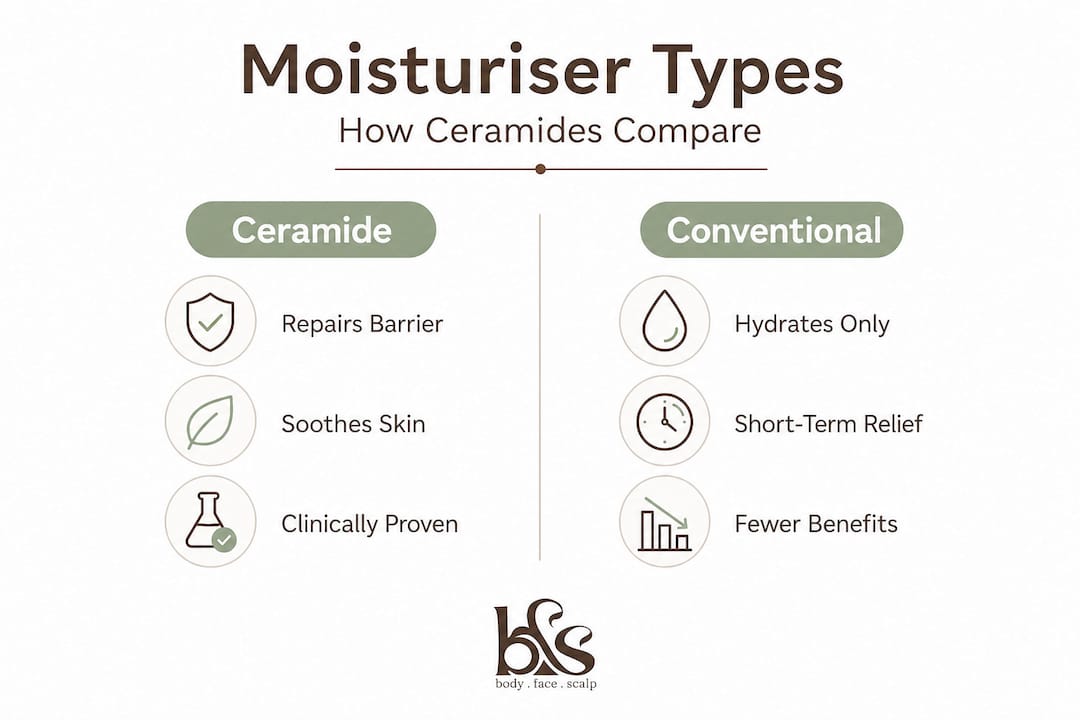
Here is how they compare:
| Moisturiser type | Primary function | Best for | Limitation |
|---|---|---|---|
| Humectant only (e.g., hyaluronic acid) | Draws in water | Oily/combination skin | Cannot repair structural barrier |
| Occlusive only (e.g., petrolatum) | Seals moisture in | Very dry, chapped skin | Does not rebuild barrier lipids |
| Emollient only (e.g., shea butter) | Smooths surface | Mild dryness | Limited therapeutic benefit |
| Ceramide-based formula | Rebuilds barrier lipids | Dry, sensitive, damaged skin | Requires correct formulation ratio |
The American Academy of Dermatology (AAD) recommends ceramide-dominant emollients as first-line treatment for xerosis, noting that barrier creams with ceramides reduce signs of dry skin by up to 47%. This is a meaningful edge over generic moisturisers, particularly for anyone dealing with chronic dryness rather than just occasional tightness.
For Canadians, this distinction is especially relevant. Central heating removes moisture from indoor air throughout the winter months. Cold outdoor temperatures reduce blood circulation to the skin’s surface. These two factors combined accelerate barrier degradation in ways that humectant or occlusive products alone cannot adequately address.
Key benefits of choosing a ceramide-based moisturiser over conventional alternatives:
- Barrier rebuilding, not just temporary hydration
- Sustained moisture retention over many hours, not just surface-level relief
- Reduced reactivity to environmental triggers over time as the barrier strengthens
- Compatibility with active ingredients like retinol or niacinamide, which can otherwise irritate a compromised barrier
For more detail on the ingredient science, explore our resources on emollients for barrier repair and barrier repair ingredients.
Not just for dry skin: Ceramide moisturisers for special skin concerns
Beyond basic dryness, ceramide moisturisers offer unique advantages for complex skin needs.
One of the most persistent misconceptions about ceramide moisturisers is that they are only useful for people with very dry or sensitive skin. The reality is more nuanced. Their mechanism, restoring the structural lipid matrix of the barrier, makes them relevant for a wide range of concerns that share a common root: barrier dysfunction.
Eczema and rosacea: A weakened barrier allows allergens and irritants to penetrate more easily, which is a primary trigger for eczema flares and rosacea flushes. By reinforcing the barrier, ceramide formulas reduce the frequency and severity of these flare-ups over time. Research supports ceramides as effective in eczema, rosacea, and psoriasis management through barrier restoration that prevents inflammatory responses.
Acne-prone skin: Many people with acne avoid rich moisturisers out of fear of clogging pores. However, non-comedogenic ceramide formulas do not block follicles and can actually support acne-prone skin by reducing the irritation caused by acne treatments like benzoyl peroxide or retinoids. A stronger barrier tolerates these actives better, meaning fewer side effects and more consistent use.
Vegan and alternative options: Not all ceramides are animal-derived. Pseudo-ceramides are lab-synthesised versions that closely mimic natural ceramides and offer a suitable option for those who prefer vegan formulations. They function similarly in terms of supporting barrier integrity and hydration retention.
Overlapping conditions: Many Canadian women manage more than one concern simultaneously, such as sensitivity plus dryness, or eczema-prone skin that is also acne-prone. Ceramide moisturisers are one of the few categories effective across all of these simultaneously, making them genuinely multifunctional.
Pro Tip: If you are currently using prescription topicals or medicated creams for eczema or psoriasis, a ceramide moisturiser can be used as a daily maintenance step between flares to strengthen the barrier and reduce how often flares occur.
Explore our sensitive skin solutions and barrier repair explained resources for guidance tailored to Canadian skin conditions and climates.
How to choose and use a ceramide moisturiser for best results
Equipped with science and insight, the final step is finding and using a ceramide moisturiser effectively.
Knowing the ingredient science is one thing. Applying it to your daily routine is another. Here is a practical, step-by-step guide to choosing and using a ceramide moisturiser so that you get the full benefit.
-
Check the ingredient label carefully. Look for ceramide NP, ceramide AP, ceramide EOP, or ceramide NS among the first six to eight ingredients. Also confirm the presence of cholesterol and a fatty acid such as linoleic or stearic acid. As noted earlier, research confirms that ceramides paired with cholesterol and fatty acids in a 3:1:1 ratio most accurately replicate the skin’s natural lipid balance.
-
Apply on damp skin after cleansing. Ceramide moisturisers work best when applied within a few minutes of washing your face or body, while the skin still holds some moisture. This traps hydration into the barrier as it absorbs.
-
Layer correctly in your routine. Apply any water-based serums first, followed by your ceramide moisturiser. If you use a facial oil or an occlusive like petrolatum at night, apply those as the final step to seal everything in.
-
Avoid over-washing and harsh cleansers. Soap-based cleansers and foaming cleansers with sodium lauryl sulphate strip ceramides directly from the skin. Switch to a gentle, pH-balanced cleanser to preserve what your moisturiser is working to restore.
-
Be consistent, especially in winter. The benefit of ceramide moisturisers builds over time. Daily, consistent application across four to eight weeks produces the most meaningful barrier repair. Do not expect overnight results, but trust the process.
-
Use on face, body, and scalp as needed. Ceramide loss is not exclusive to the face. Many Canadian women experience dry, sensitive skin on their arms, legs, and even scalp, particularly in winter. A multifunctional ceramide formula can support all three areas.
For Canadian winters specifically, consider doubling up at night with a slightly richer ceramide formula or adding an occlusive layer on particularly dry patches. Your skin repairs itself most actively overnight, making your evening routine the highest-leverage moment for barrier support.
Explore our guidance on skin hydration products and barrier-focused skincare to build out a full routine around your ceramide moisturiser.
Why the right ceramide formula makes all the difference
Here is a perspective we feel strongly about, and one that most skincare content leaves out: the word “ceramide” on a label does not guarantee that a product will actually repair your barrier.
We have seen ingredient lists where ceramide appears as the very last entry before the preservatives. At that concentration, it is unlikely to produce any measurable therapeutic effect. Brands include it for marketing purposes because the ingredient has built a credible reputation, not because the formula is genuinely designed to restore your barrier. This is one of the most frustrating patterns in the skincare industry for ingredient-conscious consumers.
What actually matters is the complete formulation, specifically whether the ceramide is supported by the right co-factors (cholesterol and fatty acids), whether the concentration is meaningful, and whether the surrounding formula is designed to stabilise and deliver the ceramide effectively. Some synthetic or pseudo-ceramides are better stabilised in modern emulsification systems than naturally extracted versions, which means a vegan formula is not automatically inferior.
We also believe that label transparency is a minimum standard, not a premium feature. You deserve to know what is in your moisturiser and in what relative quantities. Brands that disclose their ceramide types and pair them with complementary lipids are the ones worth your investment. Our barrier restoring moisturiser guide helps you cut through the marketing language and evaluate products based on what is actually inside them.
Your skin deserves more than a label claim. It deserves a formula built to perform.
Find a barrier-boosting ceramide moisturiser that fits your routine
You now have the science, the comparisons, and the practical steps. The logical next move is putting that knowledge into action with products that are genuinely formulated to deliver results.
At Body Face Scalp™, we build every formula around barrier function, with ceramides, cholesterol, and fatty acids in clinically informed ratios. Our barrier restoring moisturiser is designed specifically for women dealing with dryness, sensitivity, and barrier damage in Canadian climates. If you are ready to explore your full routine, browse our skincare collection for ingredient-led solutions across face, body, and scalp. Consistent results begin with the right foundation. We are here to help you build it.
Frequently asked questions
Are ceramide moisturisers suitable for sensitive and acne-prone skin?
Yes, ceramide moisturisers are non-comedogenic and suitable for sensitive or acne-prone skin, as they restore barrier function without clogging pores or triggering breakouts.
How fast can I see results using a ceramide moisturiser?
Most users notice reduced dryness and improved comfort within one to two weeks, while clinical studies show significant results across multiple conditions within four weeks of consistent use.
Can ceramide moisturisers replace prescription creams for eczema or psoriasis?
They are most effective as adjunct therapy and can significantly reduce severity scores for both conditions, but prescription creams may still be required during active flares.
What ingredients should I avoid when using ceramide moisturisers?
Avoid combining ceramide moisturisers with alcohol-based toners or harsh physical or chemical exfoliants in the same step, as these disrupt the barrier and directly counteract the repair ceramides are working to achieve.
Is it safe to use ceramide moisturisers in both winter and summer?
Yes, ceramide moisturisers are effective and safe year-round, protecting the barrier from dry winter air indoors and outdoors, while also defending against summer UV exposure, pollution, and humidity-related inflammation.
Recommended
- 5 most effective barrier repair ingredients for healthy skin – Body Face Scalp
- Barrier-focused skincare: The science of resilient skin – Body Face Scalp
- Sensitive skin solutions: Top expert-backed options for Canadians – Body Face Scalp
- The Ultimate Guide to Barrier Restoring Moisturizer: What It Is, Why Y – Body Face Scalp