


Barrier repair explained: restore healthy skin, reduce dryness
TL;DR:
- Canadian winter conditions increase skin barrier damage, causing dryness and sensitivity.
- Repair involves restoring lipids like ceramides, cholesterol, and fatty acids for optimal protection.
- Consistent use of lipid-rich, climate-adaptive products accelerates barrier recovery over weeks.
If your skin suddenly feels tight, reactive, or dull the moment Canadian winter sets in, your skin barrier is likely the reason. Even a carefully curated skincare routine can fall short when the barrier itself is compromised. Canadian winters increase dryness and sensitivity through low humidity and indoor heating, making barrier vulnerability one of the most common skin concerns for women across the country. This article gives you evidence-based, actionable guidance on how to identify a compromised barrier, repair it with the right ingredients, and maintain it through every season.
Table of Contents
- What is the skin barrier and why does repair matter?
- What damages the barrier and how Canadian conditions intensify it
- How barrier repair works: evidence-based routines and ingredients
- Choosing premium solutions: Canadian brands and clinical results
- Barrier repair wisdom: real-world lessons Canadian women should know
- Discover barrier-focused skincare solutions designed for Canadians
- Frequently asked questions
Key Takeaways
| Point | Details |
|---|---|
| Skin barrier function | Your barrier prevents water loss and protects your skin from irritants. |
| Canadian climate impact | Dry winters and heating in Canada accelerate barrier damage, making repair essential. |
| Evidence-based routines | Lipid-rich moisturisers and gentle cleansing restore your barrier in 2-6 weeks. |
| Premium ingredient advantage | Ultra-long-chain ceramides and balanced ratios are proven to increase hydration and resilience. |
| Smart product selection | Choose clinically validated, Canadian-focused products for sustained barrier health. |
What is the skin barrier and why does repair matter?
Your skin barrier is the foundation of healthy skin. It is the outermost layer of your skin, called the stratum corneum, and it works around the clock to keep moisture in and irritants out. Think of it as a protective shield made of skin cells (the “bricks”) held together by lipids such as ceramides, cholesterol, and fatty acids (the “mortar”). When this structure is intact, your skin stays hydrated, calm, and resilient.
According to skin barrier function research, the stratum corneum is a remarkably sophisticated system. The “brick and mortar” structure prevents transepidermal water loss (TEWL) and blocks the entry of allergens, bacteria, and environmental pollutants. When the mortar cracks, water escapes and irritants get in, causing the dryness, redness, and sensitivity you may already recognise.
Barrier repair means restoring this protective function. It is not simply about adding moisture; it is about rebuilding the lipid matrix so your skin can regulate itself again. The benefits are significant:
- Reduced dryness and tightness as water retention improves
- Lower sensitivity and reactivity as irritants are blocked
- More even skin tone as inflammation-driven hyperpigmentation settles
- Stronger resilience against seasonal and environmental stressors
For Canadian women, this matters even more. Our climate swings between harsh, dry winters and humid summers, placing the barrier under constant stress. Ceramide-rich moisturisers increase water content and measurably reduce TEWL, making them a cornerstone of any repair-focused routine.
| Barrier function | What it does | What happens when compromised |
|---|---|---|
| Moisture retention | Keeps skin hydrated | Tightness, flaking, dullness |
| Irritant defence | Blocks pollutants and allergens | Redness, stinging, breakouts |
| Microbiome balance | Supports healthy skin bacteria | Sensitivity, inflammation |
| Pigmentation regulation | Reduces inflammation signals | Uneven tone, dark spots |
Learning how to protect and repair your barrier is the single most impactful step you can take for long-term skin health. The barrier repair science behind modern formulations has advanced considerably, giving us clearer answers than ever before.
What damages the barrier and how Canadian conditions intensify it
Knowing what breaks down your barrier is just as important as knowing how to rebuild it. Damage rarely comes from a single source. It accumulates gradually, and Canadian environmental conditions accelerate the process significantly.

Dry indoor heating and low outdoor humidity during Canadian winters strip moisture from the stratum corneum faster than the skin can replenish it. The result is a cycle of chronic barrier disruption that persists for months. Add the skin barrier regeneration challenges that come with post-procedure recovery or aggressive at-home routines, and the damage compounds quickly.
Here are the most common causes of barrier damage, ranked by frequency:
- Harsh or foaming cleansers that strip natural lipids with every wash
- Over-exfoliation using acids (AHAs, BHAs) or physical scrubs too frequently
- Cold, dry outdoor air combined with heated indoor environments
- Hot showers that dissolve the lipid layer and raise TEWL
- Overuse of actives such as retinol or vitamin C without adequate barrier support
- Post-procedure “repair dip” following peels, laser treatments, or microneedling
The post-procedure repair dip deserves special attention. Many women experience a temporary but significant barrier compromise after professional treatments. This is normal, but it requires a deliberate, simplified routine to support recovery. Reaching for ingredients for sensitive Canadian skin during this window makes a measurable difference.
Understanding your personal skin sensitivity causes is also key. Some women are genetically predisposed to a thinner or more reactive stratum corneum, making them more vulnerable to all of the above triggers.
| Damage trigger | Canadian risk level | Primary effect |
|---|---|---|
| Cold, dry winter air | Very high | Elevated TEWL, tightness |
| Indoor heating | High | Chronic dehydration |
| Over-exfoliation | Moderate to high | Lipid depletion, redness |
| Hot showers | Moderate | Lipid stripping |
| Harsh cleansers | Moderate | pH disruption, dryness |
Pro Tip: During the coldest months, switch to a cream or oil-based cleanser and reduce exfoliation to once per week at most. This single adjustment can prevent significant barrier setbacks.
How barrier repair works: evidence-based routines and ingredients
Once you recognise what is damaging your barrier, rebuilding it becomes a focused, intentional process. The good news is that the science here is clear and actionable.
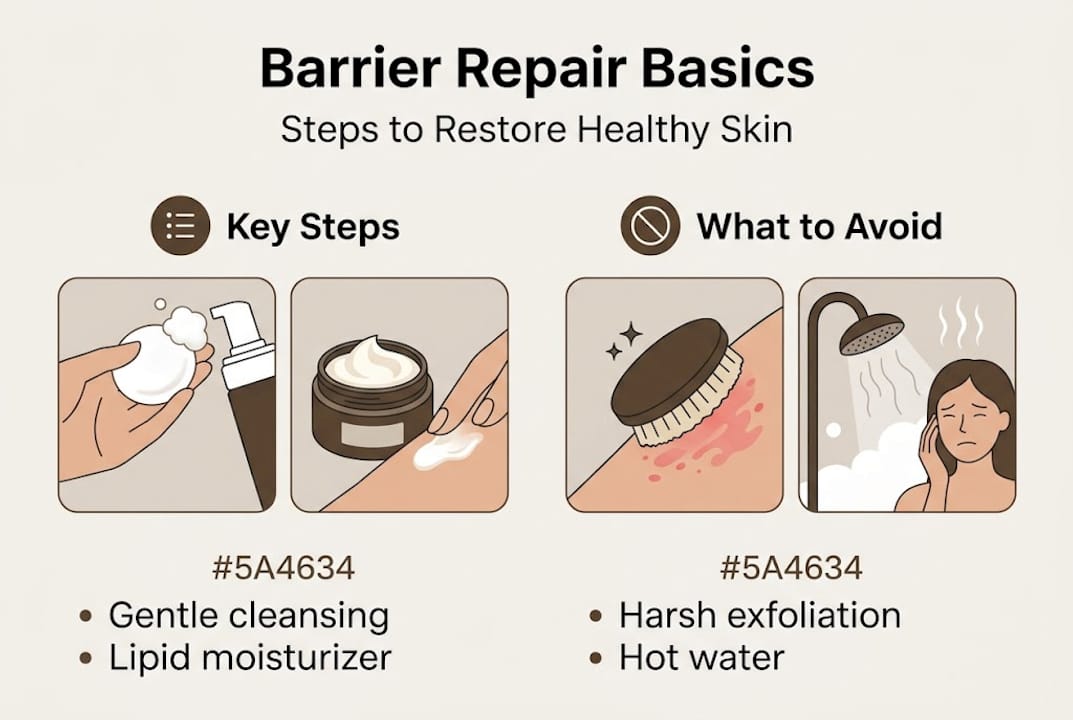
The most effective barrier repair routines share a few common principles. First, simplify. Remove anything that could be adding stress, including exfoliating acids, retinoids, and fragrance. Second, prioritise lipid replenishment with the right ingredient ratios. Research on ceramide acyl chain length shows that the optimal lipid ratio for barrier recovery is approximately 1:1:1 ceramides, cholesterol, and fatty acids, with ultra-long-chain ceramides (C24 and longer) delivering the best results.
Key ingredients to look for in a barrier repair routine:
- Ceramides (C24+): Rebuild the lipid matrix and reduce water loss directly
- Cholesterol: Works synergistically with ceramides to accelerate repair
- Fatty acids (linoleic, oleic): Restore the mortar between skin cells
- Niacinamide: Stimulates the skin’s own ceramide production and calms redness
- Hyaluronic acid: Draws moisture into the skin from the environment
- Squalane: A lightweight emollient that mimics the skin’s natural sebum
For effective ingredients for barrier repair, the combination of these actives in a single formulation is far more effective than layering multiple separate products. The ceramide moisturizer efficacy data supports this, showing consistent improvements in hydration and TEWL across diverse skin types.
In terms of timeline, most women notice initial relief within a few days of switching to a simplified, lipid-rich routine. Full barrier recovery typically takes between two and six weeks, depending on the severity of damage. Clinical data shows that a +29% hydration increase and 100% immediate improvement in skin feel are achievable with the right formulation.
Pro Tip: Apply your barrier restoring moisturizer within 60 seconds of stepping out of the shower, while skin is still slightly damp. This locks in moisture before TEWL can spike. The ultimate guide to barrier restoring moisturizer covers this technique and more in detail.
Choosing premium solutions: Canadian brands and clinical results
Not all barrier repair products are created equal. The difference between a premium formulation and a basic moisturiser often comes down to ingredient quality, lipid ratios, and ceramide chain length. For Canadian women, climate-adaptive formulations matter too.
Several Canadian and Canadian-market premium brands have published clinical results worth knowing about. Skinfix, a Canadian-founded brand, demonstrated +29% hydration and 100% immediate improvement in skin feel with its Triple Lipid-Peptide moisturiser. These results reflect what is possible when formulations are built around the correct lipid ratios and ceramide chain research.
| Brand | Key ingredients | Clinical claim | Best for |
|---|---|---|---|
| Skinfix | Ceramides, peptides, fatty acids | +29% hydration, 100% immediate improvement | Dry, sensitive, compromised skin |
| HydroPeptide | Peptides, hyaluronic acid | Smoothness and glow improvement | Ageing, dull skin |
| bareLUXE | Natural lipids, plant ceramides | Moisture retention, calming | Sensitive, reactive skin |
| Body Face Scalp | Ceramides, niacinamide, squalane | Barrier repair across body, face, scalp | All barrier concerns, Canadian climate |
When evaluating any premium product, look for these markers of quality:
- Ceramides listed with chain length (C24 or longer is preferable)
- A 1:1:1 ratio of ceramides, cholesterol, and fatty acids
- Fragrance-free formulation to avoid additional irritation
- Clinical testing data, not just marketing language
- Packaging that protects lipid integrity (airless pumps or opaque containers)
A Canadian barrier restoring moisturizer that is formulated for our climate will outperform a generic import in most cases. A holistic repair approach that considers the body, face, and scalp together also delivers more consistent results than treating each area in isolation.
Pro Tip: Read the ingredient list, not just the front label. If ceramides appear near the bottom of the list, the concentration is likely too low to produce meaningful barrier repair.
Barrier repair wisdom: real-world lessons Canadian women should know
Most barrier repair guides focus on what to buy. We want to address something more important: how to think about repair, especially in Canada’s demanding climate.
The most common mistake we see is expecting fast results from a single product. Ceramide creams improve symptoms but may not reduce TEWL in all cases, and a single application is rarely sufficient for severely compromised skin. Barrier repair is cumulative. Consistency over two to six weeks matters far more than switching products every few days.
Another overlooked factor is climate-adaptive moisturising. What works in July will not necessarily work in January. We recommend adjusting your moisturiser weight and application frequency with the seasons, not just your SPF. Exploring emollient solutions for barrier repair can help you find the right texture for each season.
Finally, know when to seek professional help. Persistent redness, chronic flaking, or eczema-like symptoms that do not respond to a simplified routine after four weeks deserve a dermatologist’s assessment. Premium skincare is powerful, but it works best as part of a broader skin health strategy.
Discover barrier-focused skincare solutions designed for Canadians
At Body Face Scalp, we built our formulations specifically around the barrier repair needs of Canadian skin. Our ingredient-led approach prioritises the ceramide ratios, lipid combinations, and climate-adaptive textures that the evidence supports.

If you are ready to take action, explore our Canadian skincare collection to find products matched to your specific concerns. Our barrier restoring moisturizer is formulated with the optimal lipid blend for Canadian conditions. Visit the Body Face Scalp website to learn more about our approach to holistic, barrier-focused skin health across the body, face, and scalp.
Frequently asked questions
How long does barrier repair take?
Barrier recovery typically takes two to six weeks for complete recovery, though most women notice initial relief within a few days of starting an evidence-based routine.
What ingredients are best for repairing the skin barrier?
Look for ceramides (C24 or longer), cholesterol, fatty acids, niacinamide, hyaluronic acid, and squalane. The optimal barrier repair ratio is approximately 1:1:1 ceramides, cholesterol, and fatty acids.
Can I use actives (retinol, vitamin C) while repairing my barrier?
It is best to pause actives and exfoliants during barrier repair. Focus on gentle cleansing and lipid-replenishing moisturisers until your skin has stabilised and feels calm again.
Is barrier repair relevant for acne-prone or sensitive skin?
Ceramide creams are non-comedogenic and safe for sensitive or acne-prone skin, making barrier repair both relevant and beneficial for these skin types.
Recommended
- The Ultimate Guide to Barrier Restoring Moisturizer: What It Is, Why Y – Body Face Scalp
- Understand your skin barrier: how to protect and repair it – Body Face Scalp
- Emollients for barrier repair: ingredient-led solutions that work – Body Face Scalp
- Holistic barrier repair for resilient Canadian skin in 2026 – Body Face Scalp