

What helps with acne scars and dark spots: your guide
TL;DR:
- Treating acne scars and dark spots requires different approaches because they are distinct skin concerns. Using the wrong products can lead to ineffective results, highlighting the importance of accurate diagnosis and targeted treatment strategies. Daily photoprotection with broad-spectrum SPF is essential to prevent dark spot worsening and support fading efforts.
If you have ever faithfully used a brightening serum for months only to feel like nothing changed, there is a good chance you were treating the wrong thing. Knowing what helps with acne scars and dark spots starts with one critical insight: these are two distinct skin concerns that require different approaches. Acne scars are structural changes in the skin’s texture, while dark spots are pigment changes called post-inflammatory hyperpigmentation (PIH). Using the same product for both is like using a hammer where you need a screwdriver. This guide breaks down exactly what works, and why.
Table of Contents
- Understanding acne scars versus dark spots
- The foundation: daily photoprotection to prevent dark spot worsening
- Topical ingredients that help fade dark spots and improve scar texture
- Professional treatments for more stubborn acne scars and dark spots
- Expert tips and nuanced approaches to acne scars and dark spot care
- Why macroscopic clarity makes all the difference in treating acne scars and dark spots
- Start your path to clearer skin with expert-recommended skincare from Body Face Scalp
- Frequently asked questions
Key Takeaways
| Point | Details |
|---|---|
| Acne scars and dark spots differ | Treating texture alone won’t erase pigment, and focusing only on spots won’t fix scar depth. |
| Daily sunscreen is essential | Broad-spectrum SPF 30+ prevents dark spots from worsening and supports fading over time. |
| Use proven skincare actives | Retinoids, vitamin C, niacinamide, and acids improve both scars and pigmentation gradually. |
| Professional treatments target stubborn scars | Chemical peels, microneedling, lasers, and fillers suit different scar types and skin tones. |
| Tailor care based on skin type | Darker skin needs gentler approaches and sequencing to reduce hyperpigmentation risks. |
Understanding acne scars versus dark spots
The terms get used interchangeably, but they describe different problems. Acne scars are physical, textural changes in the skin caused by the destruction of collagen during a breakout. They can appear as pitted (atrophic) depressions or raised (hypertrophic) bumps. Dark spots, on the other hand, are flat pigment marks left behind after inflammation fades. They are not scars at all; they are the skin’s melanin response to injury.
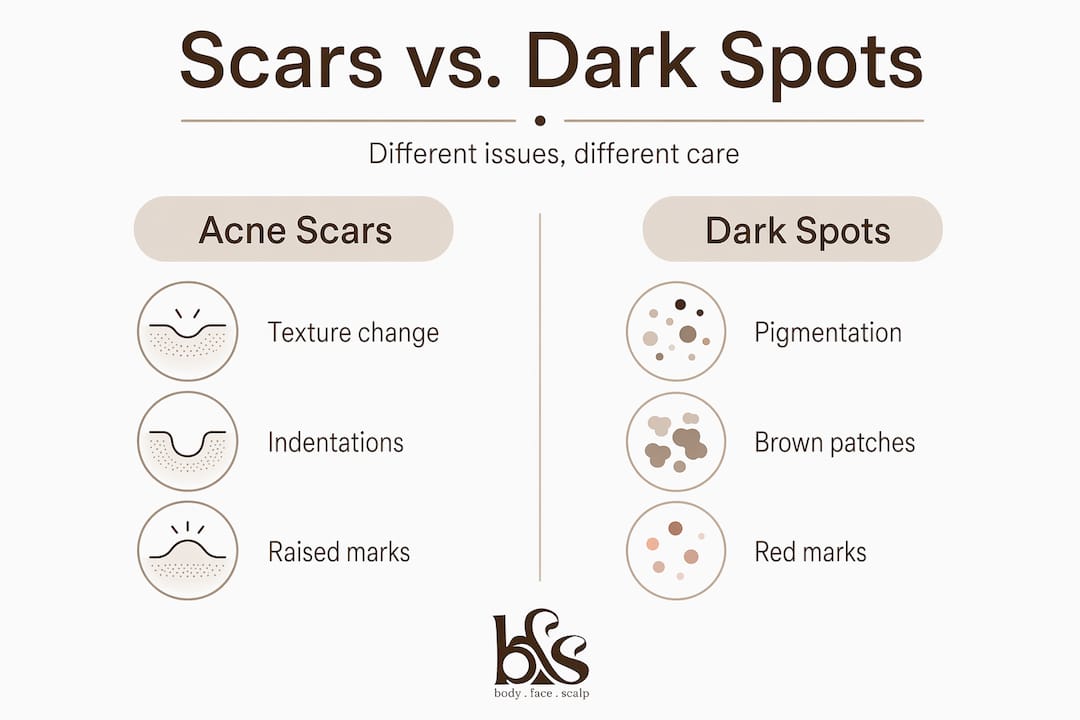
This distinction matters enormously for treatment. As Healthline confirms, treating only “texture” will not reliably erase pigment, and targeting only “spots” will not fix a depressed scar. You get far better outcomes when your approach is matched to what you actually have.
Your skin tone also plays a role in how you approach treatment. People with medium to deep skin tones produce more melanin and are more prone to PIH, meaning that aggressive treatments can actually worsen dark spots rather than improve them. Understanding your own skin type and understanding hyperpigmentation causes is genuinely the first step toward effective care.
Quick reference: key differences
- Acne scars: textural, often permanent without treatment, caused by collagen loss or overgrowth
- Dark spots (PIH): flat, pigment-based, fade over time with the right actives and sun protection
- Mixed presentation: both can appear together after the same breakout, requiring a combined approach
- Skin tone sensitivity: deeper skin tones carry higher PIH risk and require gentler treatment selection
The foundation: daily photoprotection to prevent dark spot worsening
This is non-negotiable. UV exposure triggers melanin production in existing dark spots, making them darker and significantly slowing any fading progress you have achieved with topicals. You can use the most effective brightening serum on the market and undo its work every morning by skipping sunscreen.
Strict daily photoprotection with broad-spectrum SPF 30 or higher is the foundational step that prevents existing marks from darkening and supports their fading. This applies on cloudy days, during Canadian winters, and even when you are mostly indoors near windows.
What to look for in your sunscreen:
- Broad-spectrum coverage (UVA and UVB protection)
- SPF 30 minimum, ideally SPF 50 for daily outdoor exposure
- Iron oxides in the formula, which provide additional protection against visible light that can worsen PIH
- A water-based or lightweight texture that sits well under makeup or moisturiser
Our daily broad-spectrum sunscreen is formulated with exactly these priorities in mind, making it easy to protect your skin every day without a greasy finish.
Pro Tip: Reapply your sunscreen every two hours when outdoors or after sweating. A single morning application does not hold up through a full day outside, especially during summer activities.
Sunscreen works best as part of a system. Pairing it with pigment-targeting actives morning and evening accelerates results in a way that neither approach achieves alone.
Topical ingredients that help fade dark spots and improve scar texture
This is where ingredient-conscious skincare becomes genuinely exciting. Several well-studied actives address both pigmentation and texture, though they work through different mechanisms and suit different skin types. Focusing on high-impact actives like retinoids, niacinamide, vitamin C, AHAs, BHAs, and azelaic acid yields better long-term outcomes for both scars and dark spots.
Here is a breakdown of the most effective ingredients and how to use them:
| Ingredient | Primary benefit | Best used | Suited for sensitive skin? |
|---|---|---|---|
| Retinoids | Collagen stimulation, cell turnover | Evening, with gradual introduction | Start slowly; can cause irritation |
| Vitamin C | Brightening, antioxidant protection | Morning, under sunscreen | Stable forms (ascorbyl glucoside) suit sensitive skin |
| Niacinamide | Reduces PIH, calms inflammation | Morning or evening | Yes, very well tolerated |
| AHAs (glycolic, lactic) | Surface exfoliation, texture smoothing | Evening, 2-3x weekly | Lactic acid is gentler |
| BHAs (salicylic acid) | Pore clearing, anti-inflammatory | Evening, especially for acne-prone skin | Moderate tolerance |
| Azelaic acid | Inhibits melanin production | Morning or evening | Excellent for sensitive and rosacea-prone skin |
| Tranexamic acid | Targets stubborn pigmentation pathways | Morning or evening | Yes, very well tolerated |
Key usage notes:
- Retinoids are among the most evidence-backed options for both scar texture and PIH. Start with a low-concentration retinol two nights per week and build from there.
- Vitamin C works best at around a 10-15% concentration and should always be followed by SPF in your morning routine.
- Niacinamide at 5-10% is one of the most versatile actives available. It reduces the transfer of melanin (the pigment) to skin cells and calms the inflammation that drives PIH in the first place.
- Azelaic acid is underrated for stubborn dark spots. At 10-20%, it inhibits the enzyme tyrosinase, which is responsible for pigment production.
Pro Tip: Do not layer multiple potent actives at once when you are starting out. Introduce one new ingredient at a time over two to four weeks. Irritation is a barrier breakdown, and a damaged skin barrier will worsen PIH, not improve it.
For a more detailed breakdown of how to build an active-focused routine, our hyperpigmentation treatment guide walks through sequencing, timing, and combinations that work.
Professional treatments for more stubborn acne scars and dark spots
Topicals are your everyday workhorse, but some structural scars and deeply set pigmentation respond better to professional procedures. Chemical peels, microneedling, laser resurfacing, and fillers are used for different scar types, from raised keloid scars to sunken atrophic ones.
Here is a practical overview of the main options:
- Chemical peels: Apply an acid solution to resurface the skin, improving texture and fading pigment. Superficial peels (lactic, mandelic) suit darker skin tones. Medium and deep peels carry higher PIH risk and require experienced practitioners.
- Microneedling: Creates controlled micro-injuries that stimulate collagen production. It is one of the more skin-tone-inclusive options because it carries lower PIH risk than heat-based treatments.
- Laser resurfacing: Ablative lasers (like CO2) deliver strong results for atrophic scars but require careful use on medium to deep skin tones due to significant PIH risk. Non-ablative options are generally safer across a wider range of tones.
- Dermal fillers: Hyaluronic acid fillers can temporarily plump depressed scars for an immediate improvement in appearance. Results are not permanent but can be a useful bridge while collagen-building treatments take effect.
- Subcision: A needle technique that physically breaks up the fibrous tissue tethering depressed scars to deeper skin layers. Often combined with microneedling for better results.
For higher PIH-risk skin, procedural selection and the intensity of treatment matter significantly. Conservative energy settings and proper pigmentation-preventive sequencing reduce the risk of making things worse.
Pro Tip: Always start a pigment-targeting topical routine for four to six weeks before undergoing any collagen-stimulating procedure. This suppresses the melanin response and significantly reduces post-procedure PIH risk.
For a curated look at the most effective options, our guide on top acne scar treatments covers both clinical procedures and supportive skincare in detail.
Expert tips and nuanced approaches to acne scars and dark spot care
Getting results comes down to consistency and clarity, not the number of products you use. Here are the principles we see making the biggest difference:
- Treat PIH and texture separately. Build your routine around one primary concern and add secondary support. Trying to address everything simultaneously often leads to irritation and stalled progress.
- Introduce actives gradually. A compromised skin barrier worsens PIH. Slow, steady introduction of retinoids or AHAs protects your barrier and makes your routine more sustainable.
- Darker skin tones need a conservative-first approach. Start with the gentlest effective option (azelaic acid, niacinamide, lactic acid) and escalate only if needed. Monitoring for new or worsening pigment is essential at every stage.
- Sunscreen is maintenance, not optional. Every expert-recommended routine treats photoprotection as the anchor. Without it, no brightening treatment will hold.
The biggest single booster for your results is not stacking more actives; it is combining pigment-targeting topicals with strict photoprotection to prevent the pigment pathway from being re-stimulated every day.
For more in-depth strategies, particularly if you are managing moderate to severe PIH, our article on expert hyperpigmentation strategies covers layering actives, barrier care, and common mistakes to avoid.
Why macroscopic clarity makes all the difference in treating acne scars and dark spots
Here is the view we hold at Body Face Scalp that most skincare content glosses over: the single biggest reason people feel frustrated with their results is mislabelling. They call a dark flat mark a “scar” and spend months using collagen-stimulating treatments that will never touch pigment. Or they call a pitted depression a “dark spot” and layer brightening serums over a structural problem.
Clinicians often use “acne scars” broadly to include both PIH and structural scars. When a practitioner prioritises treatment based on which concern actually predominates, outcomes improve significantly. This is not a minor technicality; it is the difference between six months of progress and six months of frustration.
Sequencing matters especially for skin of colour. Practitioners who understand this will almost always establish pigment control first, then introduce collagen-stimulating procedures. Starting a laser series on uncontrolled PIH is a recipe for a worse outcome. This is the kind of nuance that gets lost in one-size-fits-all skincare advice, and it is precisely what we want you to bring into your conversations with both your skincare provider and your product choices. Our holistic hyperpigmentation routines reflect this sequenced, skin-biology-first thinking throughout.
Start your path to clearer skin with expert-recommended skincare from Body Face Scalp
You now have a clear framework: know what you are treating, protect against UV daily, introduce proven actives thoughtfully, and seek professional care when topicals have reached their limit.
Body Face Scalp™ is a Canadian skincare brand built specifically to support this kind of intelligent, ingredient-led approach. Our Canadian skincare collection includes formulations designed for barrier repair and hyperpigmentation support, including our barrier restoring moisturizer that helps your skin tolerate actives without inflammation. Whether you are building your first PIH-focused routine or supporting recovery after a professional treatment, our skin care essentials are formulated with Canadian climate and skin diversity in mind.
Frequently asked questions
What daily skincare step is most important to prevent acne dark spots from getting worse?
Consistent use of a broad-spectrum SPF 30+ sunscreen is the most important step. Without it, UV exposure continuously re-stimulates melanin production, undoing the progress of any brightening treatment you are using.
Can topical products alone remove all acne scars and dark spots?
Topicals are highly effective for pigment-based dark spots and mild texture changes, but combination approaches yield better results for deeper or structural scars, which often benefit from professional procedures like microneedling or subcision.
Are professional treatments safe for darker skin tones prone to post-inflammatory hyperpigmentation?
Yes, when performed by experienced providers using conservative energy settings and proper pigmentation-preventive protocols, many professional treatments are safe and effective for darker skin tones. Preparation with topical pigment control beforehand is strongly advised.
Which ingredients are recommended for ingredient-conscious people to treat acne dark spots?
Azelaic acid, niacinamide, vitamin C, and gentle retinoids are among the most evidence-backed options for post-acne dark spots. They are generally well tolerated and can be built into a straightforward routine without overwhelming the skin.
Recommended
- Top hyperpigmentation remedies: proven examples for clear skin – Body Face Scalp®
- How to manage hyperpigmentation: 5 expert steps – Body Face Scalp
- Hyperpigmentation treatment guide: Holistic routines & actives – Body Face Scalp®
- Understanding hyperpigmentation: causes, types, and care – Body Face Scalp®